Table of contents
Table of contents
Key takeaways
- Horizontal integration is a growth strategy to expand market share by merging with or acquiring competitors in the same industry.
- Adopt a centralized financial infrastructure before the deal. closes to prevent reporting delays across the combined business AI-native ERP automates multi-entity consolidation, continuous close, and real-time visibility at entity and group level.
- Intuit Enterprise Suite supports horizontal growth with embedded intelligence and enterprise-grade financial management.
When you acquire a competitor, the deal adds another set of financials to fold into a single, reliable consolidated view of group performance. According to the 2024 Intuit QuickBooks Business Solutions Survey, 82% of businesses are prioritizing expansion over the next year, and 86% are focused on increasing revenue and profitability.
While horizontal integration delivers both, it also introduces extra complexity through multi-entity reporting, intercompany transactions, and the potential for increased regulatory scrutiny, which you must plan for. Below, we cover the key forms of horizontal integration and how an AI-native ERP helps you manage the financial complexity that follows every deal.
Horizontal integration defined
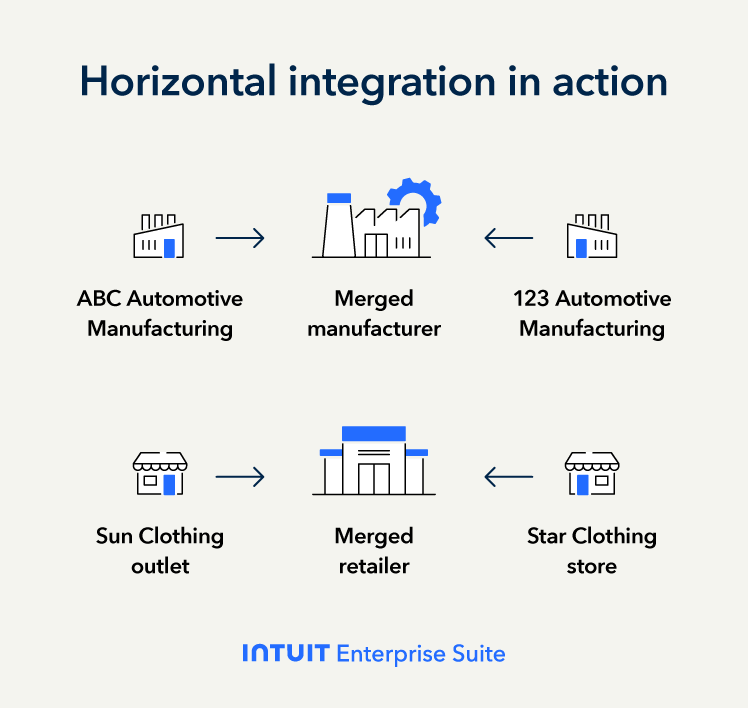
Horizontal integration is a multi-entity expansion strategy that involves acquiring a competitor at the same stage of the supply chain. For the finance leader, this expansion requires immediate consolidated visibility and control over a larger, more complex operational footprint.
Expanding market share through acquisition increases the complexity of intercompany eliminations and month-end reporting.
3 key forms of horizontal integration
Mergers, acquisitions, and internal expansion are three different types of horizontal integration. Each approach has its own implications for entity management and financial reporting.
Method 1: Merger
Mergers bring two companies together, combining resources, expertise, and customer bases into one stronger entity. They offer immediate access to new markets and capabilities, allowing businesses to scale faster than they could through organic growth alone.
A good example of horizontal integration is the 2019 merger between Fiserv and First Data. For Fiserv, the deal expanded its payment processing capabilities and customer base by bringing First Data’s merchant payment solutions into the group.
For single-entity businesses, a merger is a direct route to scale. Combining production, distribution, and administrative functions across merged entities improves efficiency and margin. But the deal also means running two sets of processes, controls, and approval workflows on systems that were built for one. Without a shared reporting structure, every consolidated view requires manual work that slows the close and introduces error.
For mid-market businesses already managing multiple entities, each additional merger raises the bar even higher. You need consolidated reporting that covers the new entity from day one, intercompany accounting that scales with every pair you add, and compliance governance that holds across the wider group. The financial infrastructure that worked for five entities may not hold at ten without redesign.

Method 2: Acquisition
In an acquisition, one company fully buys another, integrating its assets, operations, and workforce to grow its capabilities, enterprise value and market position.
A notable example of horizontal consolidation through acquisition is Salesforce’s acquisition of Tableau. Salesforce integrated Tableau's data visualization and analytics platform into its cloud-based suite, strengthening its position in the data-driven enterprise market.
Acquisitions give mid-market businesses immediate access to the acquired company's customers, technology, and market presence. The acquiring company also retains its brand and control over strategic decisions.
For a single-entity acquirer, the challenge starts with absorbing a second set of books built on a different chart of accounts and different reporting conventions. For businesses already operating across multiple entities, each acquisition adds another system to run in parallel until the data is migrated and mapped to the group standard.
The process is also among the most complex integration exercises. Misalignment in goals, processes, or company culture leads to operational disruptions, increased costs, and a loss of key talent, potentially outweighing the expected benefits.
The biggest financial risk is data silos, where the acquired company’s financials remain disconnected from the parent organization. This fragmentation can delay consolidated reporting and obscure the overall group’s true financial position. An AI-native ERP brings the new entity's data into a single consolidated view without requiring a full platform migration. This means you can report on the combined business without waiting for a full system rebuild.

Method 3: Internal Expansion
Internal expansion involves scaling a company’s existing operations to enter new markets or expand offerings. While not always labeled as “horizontal integration,” this approach serves similar purposes, allowing companies to grow within their industry.
A single-entity mid-market business opening a second location or launching a new product line doesn't always recognize that it has become a multi-entity operation. It expands its financial systems, reporting structures, and controls piecemeal, but by the time it’s running five or six entities, it realizes the infrastructure wasn't designed for this scale.
A prime example is HubSpot’s development of HubSpot Academy. Initially focused on marketing automation tools, HubSpot expanded its offerings by creating an education platform that provides free resources and certifications.
This approach allows for controlled, gradual growth, strengthening the company’s market position without the risks of blending cultures or facing regulatory issues common in mergers or acquisitions.
Though it requires substantial upfront resources and time, internal expansion enables companies to deepen customer relationships and reinforce brand identity sustainably. The financial challenge is that each new location or product line often runs on its own workarounds, and shared costs go unallocated across entities.
An AI-native ERP system handles operational integration during and after expansions as new locations or product lines come online, consolidating reporting across the expanding group. This gives you entity-level profitability to decide where to invest, reprice, or wind down.

Vertical vs. horizontal integration differ: How do they differ?
While horizontal integration grows a company’s presence within the same industry, vertical integration is about gaining control over different stages of the supply chain.
For finance leaders, the distinction between the two matters most in how it changes reporting:
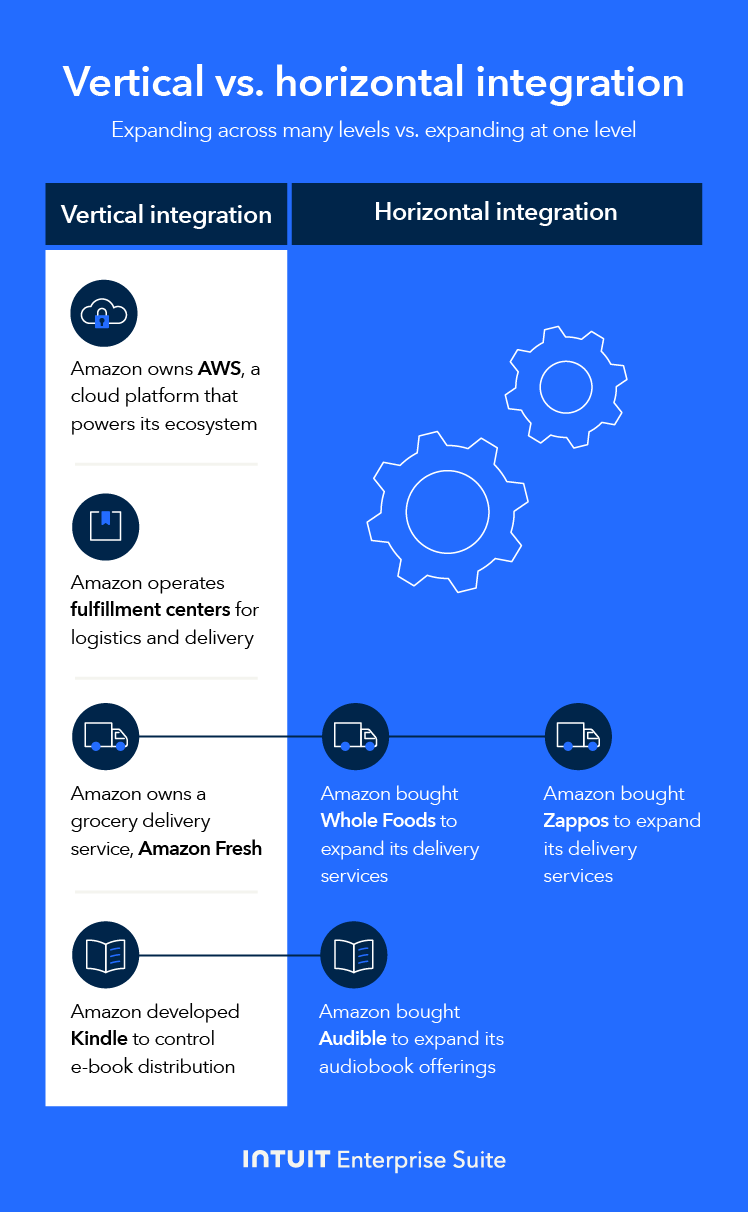
These two cases illustrate horizontal and vertical integration in practice:
HubSpot’s acquisition of The Hustle in 2021 is an example of a horizontal acquisition. It added a media business alongside its existing marketing and CRM platform, giving it a new avenue to engage its audience, while remaining focused on serving businesses within the same industry. That expansion required consolidated reporting across both entities.
By contrast, Amazon illustrates vertical integration by managing multiple stages from warehousing and distribution to direct product sales. It added supply chain stages, each with its own cost structure to track from procurement through to delivery.
Pros and cons of horizontal integration
Horizontal integration creates strategic advantages, but it also introduces financial and operational risks worth weighing before committing. Below is a breakdown of the primary benefits and considerations of horizontal integration:

Before pursuing horizontal integration, consider cultural fit, customer overlap, and regulator risks to ensure long-term value beyond immediate cost savings.
How an AI-native ERP supports horizontal integration
Post-acquisition, the mandate shifts from deal valuation to operational control. The primary hurdle at this point is the period of data latency, where the new entity’s financials remain siloed from the group core.
Here are three capabilities an AI-native ERP delivers to get to a single, reliable financial view faster:
Intelligence embedded at the core
After a horizontal acquisition, the finance team often inherits a fragmented tech stack that obstructs reporting and compliance. According to insightsoftware, 82% of finance teams cite poor tool integration as their biggest hurdle to accurate forecasting.
Instead of manually mapping the new subsidiary's chart of accounts to the group ledger, Intuit Enterprise Suite uses embedded AI to automate data ingestion and anomaly detection.
The result is you shift from reactive reporting to strategic planning. In L.E.K. Consulting's 2025 Office of the CFO Survey, 56% of CFOs said they prefer AI embedded within their finance platform over standalone tools, citing faster time to value and fewer integration dependencies.
Continuous close across entities
Each new entity exponentially increases the complexity of intercompany eliminations. While 10 entities create 45 intercompany pairs, 20 entities create 190. Without automation, this volume creates month-end compression, delaying the delivery of financial insights.
Intuit Enterprise Suite resolves this by operationalizing a continuous close. By automating the processes that cause month-end bottlenecks, you ensure the numbers are decision-ready at the end of the period, not days later.
The result is that the numbers are decision-ready when the period ends, not days after it. Gartner predicts that cloud ERPs with embedded AI will deliver a 30% faster financial close by 2028.
Scalable growth without re-platforming
Horizontal integration increases transaction volume and operational complexity faster than most ERP systems can handle. Capital allocated to replacing or migrating to a new platform is capital not deployed on the next acquisition. Plus, migration often requires months of planning, data extraction, parallel running, and retraining.
Intuit Enterprise Suite scales as entities are added to the group, so integration work occurs on a single platform rather than multiple platforms. Here is what that means in practice:
- No platform migration for QuickBooks users: Any entities acquired already using a QuickBooks platform connect to your existing system
- Entity count grows without changing platforms: There is no ceiling to Intuit Enterprise Suite, meaning it handles the 20th entity onboarding in the same way as the second
- Predictable implementation: Each new acquisition requires financial configuration, but this is mapped onto a known platform, rather than having to start afresh with a new vendor
In an acquisition drive, due diligence and cultural integration already consume leadership time. Onboarding every new entity onto Intuit Enterprise Suite simplifies the financial integration.
A Forrester TEI study commissioned by Intuit projected 299% ROI over three years for a composite 10-entity firm, including $127,334 in intercompany transaction savings and $139,940 in reporting efficiencies.
Horizontal integration impact on market power and competition
Horizontal integration changes the competitive dynamics of an industry and, with that, the regulatory environment in which you operate.
Market concentration
Horizontal integration often leads to higher market concentration, where fewer companies control a greater market share. While this can boost your price control and bargaining power, it also narrows consumer options and impacts market diversity.
For instance, after Facebook acquired Instagram, it consolidated its dominance in social media, influencing market dynamics, user options, and advertiser costs.
Monopoly concerns
As you gain market share through successive deals, there’s a risk of monopoly behavior, which can reduce competition. This can stifle innovation, restrict market entry for new players, and drive up consumer prices. Major mergers in industries such as technology and telecommunications are frequently subject to regulatory scrutiny to ensure fair competition.
Regulatory and antitrust issues
Regulatory agencies actively monitor horizontal acquisitions to reduce anti-competitive practices. Antitrust laws protect consumer interests and keep markets open to competition.
When an acquisition or merger threatens to create a monopoly, regulators may impose restrictions or block the deal, as seen in the JetBlue and Spirit Airlines merger we mentioned earlier.
If the Federal Trade Commission (FTC) and DOJ have reason to believe that a merger violates antitrust laws, the deal can be blocked. And existing mergers that have subsequently harmed competition can also be investigated.

The FTC and DOJ created Merger Guidelines and Horizontal Merger Guidelines to outline situations that could warrant enforcement action.
Examples of horizontal integration
Horizontal integration is a growth strategy that works for many businesses. Here are some notable horizontal integration examples:
- Disney and Pixar: When Disney acquired Pixar, the business enhanced its animation capabilities and combined creative resources, resulting in blockbuster hits earning billions. This strategy strengthened Disney’s market dominance in animated movies and expanded its creative offerings.
- Disney and Marvel: Disney’s acquisition of Marvel Entertainment helped the business go beyond the princess market, adding superheroes to its portfolio. The Marvel Cinematic Universe diversified Disney’s offerings and strengthened its position in the action-adventure film genre, drawing wider audiences and driving record revenues.
- Facebook and Instagram: Facebook’s acquisition of Instagram captured a younger demographic and consolidated its hold on the social media landscape. By integrating Instagram’s platform, Facebook expanded its user base and enhanced its advertising capabilities, leveraging Instagram's popularity for increased engagement and revenue.
- Marriott and Starwood Hotels: The merger of Marriott International and Starwood Hotels created the world’s largest hotel chain, significantly increasing Marriott’s market share. This horizontal integration allowed the company to enhance its global presence, offer more choices to customers, and achieve economies of scale through streamlined operations.

Boost productivity and enhance profitability
Every horizontal acquisition adds reporting complexity, intercompany activity, and another entity to close. The difference between a deal that delivers value quickly and one that doesn't is having a financial integration plan in place from day one post-completion.
Intuit Enterprise Suite removes the infrastructure bottleneck from your acquisition strategy, giving you enterprise-grade financial management that scales with every entity you add, without starting over each time.
To find out more about Intuit Enterprise Suite, book a call with one of our consultants to walk through your requirements and get a tailored demo.
Check out upcoming events and learn more about Intuit Enterprise Suite.

Customer stories

Case study
Business growth guide: Proven strategies to scale your business

Case study
How FEFA Financial scaled up with Intuit Enterprise Suite (No ERP migration needed)

Case study
Case study: Fire & Ice transforms multi-entity challenges with Intuit Enterprise
October 25, 2024

Case study
Four Points RV Resorts review: Why they chose Intuit Enterprise Suite over NetSuite
October 25, 2024

Case study
Humble House Foods case study: How they improved visibility & simplicity using Intuit Enterprise Suite
September 24, 2025
More on acquisitions & mergers

Funding ownership
Venture capital funding: What is VC funding, how to choose investors & negotiate equity
January 27, 2025

Funding ownership
Horizontal integration: Definition, pros & cons, vertical vs. horizontal integration comparison
October 23, 2025

Acquisition mergers